Attaching calendars
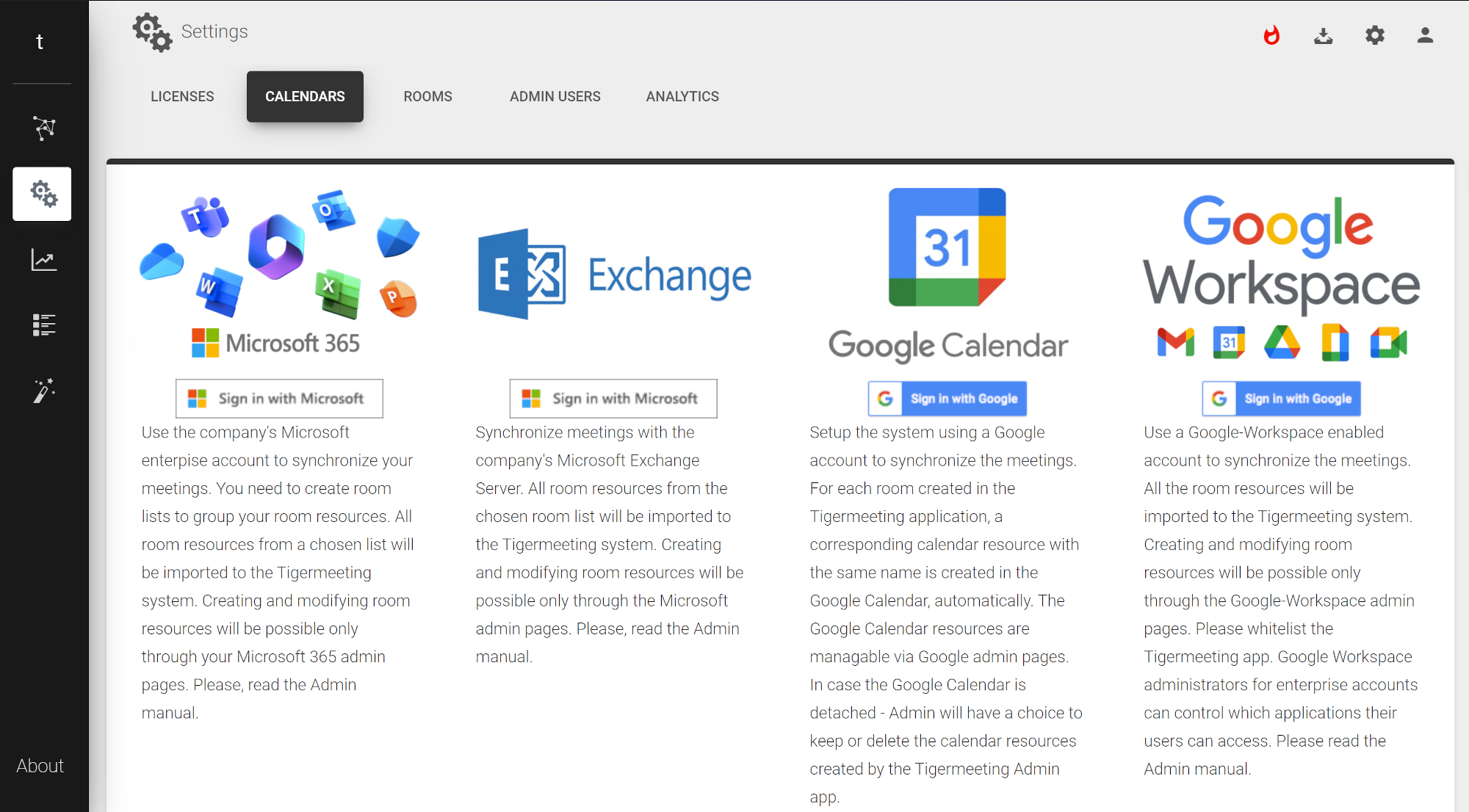
We offer full support for Microsoft 365, Microsoft Exchange Server on-premises, Exchange Online, Google Workspace, Google Calendar, CalDAV, Zoho Workplace, Odoo ERP, Yandex 360, LarkSuite and Feishu as well as the iCalendar/Webcal based calendar integrations.
 |
 |
 |
 |
 |
 |
 |
 |
 |
 |
 |
 |
Both, the Google cloud app and the Microsoft Azure app are verified by the respective supplier and certified for calendar operations scope that Tigermeeting performs.
The same is valid for the Lark and the Feishu Tigermeeting apps that are verified and approved apps globally and in mainland China respectively.
...also a "Local Calendar" is available, when the devices sync the events between themselves without any external calendars attached.
An easy wizard helps you to connect to your current infrastructure.
From the Admin App, all devices connected to the Tigermeeting solution are centrally configured and managed.
iCalendar files are most often created by one of the widely available iCalendar generator programs. Tigermeeting's flexible design allows calendar supplier to replace and update the iCal files - as long as the URL pointing to the file does not change, the room configuration does not need to be updated.
This feature opens a new era in cost effective meeting room management for all those customers who cannot appreciate or are not willing to pay recurring costs for a commercial online calendar service (like Google, Microsoft, Zoho, Yandex360 or Lark/Feishu)
Files following the RFC 5545 specification are distributed via an ordinary web server or free calendar services like Personal Google calendar or Carbonio CE. This is a very efficient and cost effective way of distributing huge number of relatevily static, read-only calendars that suit well for school and university operations' use case.
CalDAV is a network protocol defined by the IETF that allows clients to access, manage, and synchronize calendar data and scheduling information on a remote server. It builds upon the WebDAV protocol and relies on iCalendar to structure the calendar data.
Core CalDAV Standards follow the RFC 4791 - The foundational CalDAV specification. RFC 6638, that defines the scheduling extensions for CalDAV. It allows servers to automatically process and send scheduling messages between users (implicit scheduling) - and the iCalendard RFC 5545 specification, which is the data format CalDAV uses to store and transfer calendar information.
CalDAV provides an open standard flexibility to connect and use with many differnt bi-directional calendars, like Zimbra, Zextras Carbonio, IceWarp, Baikal, SOGo, Skedda, Horde, Nextcloud, ownCloud, OX, Radicale, SabreDAV etc.
Read more on supported cloud-native and soverein calendars at the supported calendars page.
